
Canada Low-Wage LMIA Changes: Up to Two Years, New Exception for Early Childhood Educators
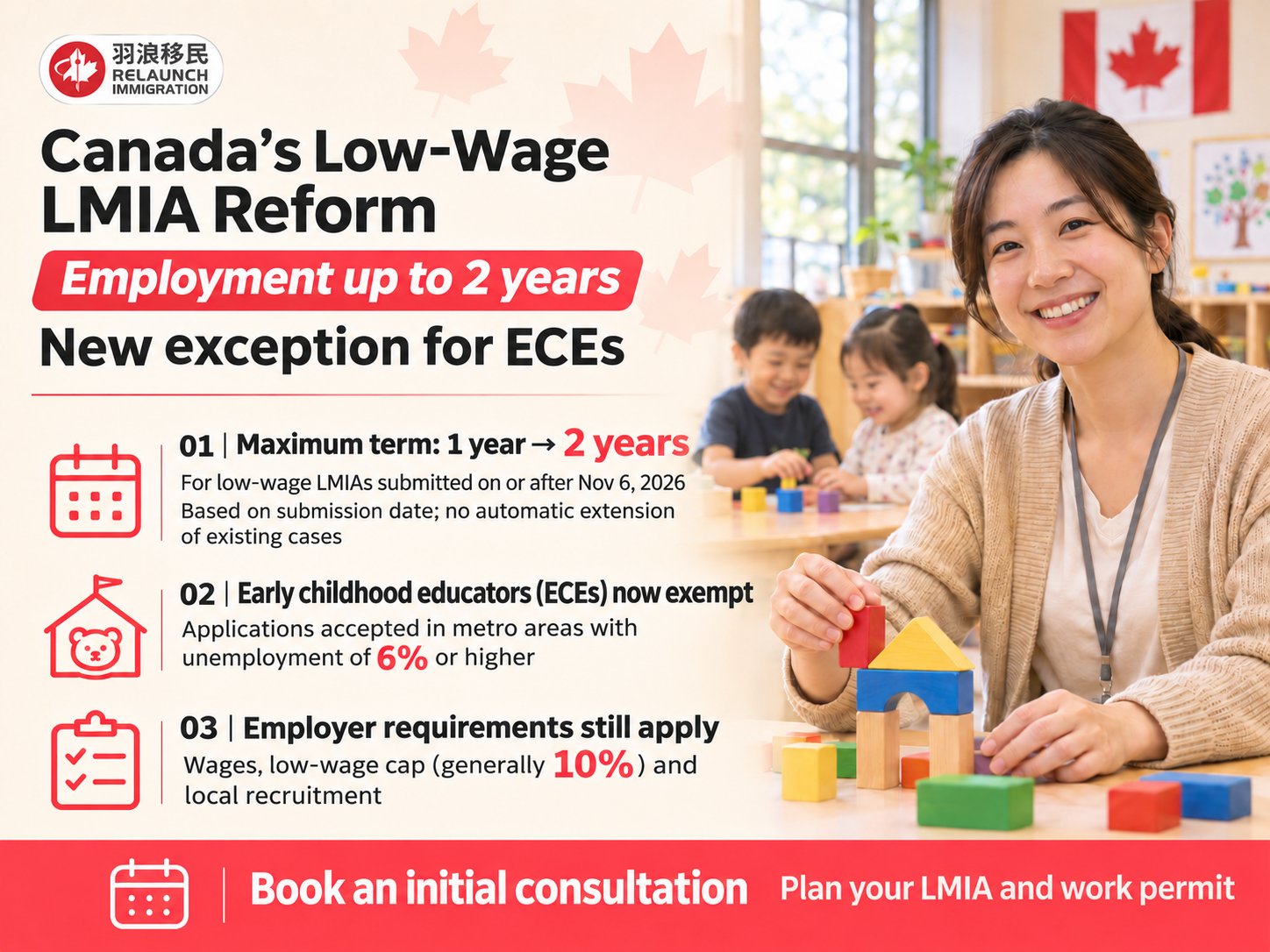
Since November 6, 2026, Canadian employers applying for a Labour Market Impact Assessment (LMIA) under the low-wage stream can request an employment duration of up to two years, up from one year. For daycares and child care centres, a second change matters just as much: eligible Early Childhood Educator (ECE) positions can now be processed even when the workplace is in a census metropolitan area with an unemployment rate of 6% or higher. Both measures are already in effect.
In this article:
- ➜ 1. Low-wage LMIAs now up to two years: how long can the worker stay?
- ➜ 2. Can child care centres in high-unemployment areas now hire ECEs?
- ➜ 3. Three things employers should check before applying
- ➜ 4. Which regions may change from March 2027?
- ➜ 5. What a low-wage LMIA means for permanent residence
1. Low-wage LMIAs now up to two years: how long can the worker stay?
The new maximum applies to low-wage LMIA applications submitted on or after November 6, 2026. Employers can request up to two years based on their actual staffing needs.
The submission date decides which rules apply. An application submitted on November 5 and still in processing on November 6 is not automatically extended. Workers who already hold a work permit should still plan renewals around the expiry date on their current permit.
Three timelines that are easy to mix up
| Timeline | What it means for employers and workers |
|---|---|
| Employment duration supported by the LMIA | Employers can request up to two years. Service Canada assesses the supportable period case by case. |
| Window to use the LMIA for a work permit | A positive low-wage LMIA is generally valid for up to six months. The worker must apply for the work permit before the expiry date on the approval letter. |
| Work permit validity | Immigration, Refugees and Citizenship Canada (IRCC) decides whether to issue the permit and for how long. Even with a two-year LMIA, the worker still needs a matching work permit. |
2. Can child care centres in high-unemployment areas now hire ECEs?
Yes. Normally, if a position pays below the provincial or territorial wage threshold and the workplace is in a Census Metropolitan Area (CMA) with unemployment of 6% or higher, Service Canada will refuse to process the low-wage application. From November 6, ECEs are an exception to this rule. Child care centres must still meet local recruitment, wage and low-wage workforce cap requirements.
Example: British Columbia
Official unemployment rates for applications submitted from October 9, 2026 to January 7, 2027:
New ECE exception applies
New ECE exception applies
Below 6%, exception not needed
Employers with several locations should check the full postal code of the location where the worker will actually work, against the official figures for the period of submission.
Does it cover Early Childhood Educator Assistants (ECEAs)?
NOC 42202 includes both early childhood educators and assistants, but the November 6 announcement specifically refers to early childhood educators and does not mention assistants separately. Employers hiring for an ECEA role should prepare the duties and requirements and confirm with Service Canada before relying on this exception.
3. Three things employers should check before applying
1. Which stream does the hourly wage fall into?
In British Columbia, for applications received from July 17, 2026, an hourly wage below CAD 38.40 falls under the low-wage stream, and CAD 38.40 or more falls under the high-wage stream. This threshold only determines the stream. The wage you must actually pay is the higher of the local median wage for the occupation on Job Bank and the wage you pay current employees in the same job, location, skills and experience.
Job Bank is scheduled to update its wage data on November 18, 2026. Employers applying on or after that date should check the wage again.
2. How many low-wage positions are left at the workplace?
The general cap is 10% of the workforce at that location. Designated sectors such as construction, food manufacturing, hospitals and nursing and residential care facilities may use 20%. The ECE exception relates to the unemployment rule only, so a child care centre cannot use the 20% cap simply because it hires ECEs.
This matters especially for small centres: under the official calculation, a workplace with fewer than 10 employees under the general 10% rule can hire at most one low-wage temporary foreign worker, and existing positions count toward that limit.
3. Is your local recruitment complete?
- Job ads must run for at least 8 consecutive weeks within the 3 months before you apply.
- You generally need to use Job Bank plus at least two other suitable recruitment methods that reach different under-represented groups.
- You must be able to show recruitment efforts toward youth aged 15 to 30.
- At least one recruitment activity must continue until the LMIA decision.
- Ads and recruitment records must be kept for at least 6 years.
4. Which regions may change from March 2027?
The federal government has also proposed regional reforms with a target date of March 1, 2027, depending on whether each province or territory opts in. Employers preparing an application now should assess eligibility under the current rules.
| Workplace location | Proposed approach |
|---|---|
| CMAs with unemployment of 6% or higher | Continue refusing to process low-wage applications, with exceptions for priority sectors. |
| Large CMAs (population over 250,000) with unemployment below 6% | Access for occupations listed in the Canadian Occupational Projection System (COPS); participating provinces and territories can add or remove occupations. |
| Rural areas of large CMAs and smaller CMAs (100,000–250,000) | Targeted access based on an occupation list that participating provinces and territories can adjust. |
| Rural communities outside CMAs | Continued access to all occupations in the low-wage stream; other requirements still apply. |
Will the general cap rise from 10% to 15%?
Under the 2027 proposal, participating provinces and territories can identify communities where eligible employers may use a 15% cap, while priority sectors keep their 20% cap.
Separately, temporary rural measures introduced in 2026 remain in place until March 31, 2027, and provinces have made different choices. For example, B.C. lets eligible rural employers keep existing proportions above the cap, while Nova Scotia also allows eligible rural employers to use a 15% cap. Employers should check which measures apply based on their workplace and submission date.
5. What a low-wage LMIA means for permanent residence
A positive LMIA supports the worker's work permit application. Workers who want to become permanent residents still need to qualify separately through a Provincial Nominee Program or another economic immigration program.
In the same announcement, the federal government said it will offer additional provincial nomination spaces through a time-limited measure to help provinces and territories retain workers already in Canada. A low-wage LMIA on its own does not lead to a provincial nomination.
On implementation, Budget 2026 proposes CAD 151.5 million over five years to improve service delivery and strengthen employer compliance, and CAD 82 million over four years for migrant worker support programs that help foreign workers understand and exercise their rights.
Official source: ESDC news release: Targeted reforms to the Temporary Foreign Worker Program (November 2026)
Need help with your LMIA or work permit plan?
Whether you are an employer planning to hire foreign workers or a worker planning a renewal and a path to permanent residence, your submission date, wage stream, workforce cap and recruitment records all affect the outcome. Book an initial consultation with Relaunch Immigration and we will help you map out your next step based on your location and situation.