Canada Immigration Levels Plan 2027-2029: Impact & Strategy for PR Applicants
Quick Navigation:
- ➜ I. Overview of Main Immigration Quotas for the Next Three Years
- ➜ II. What is the Measure for Up to 200,000 Inland PR Transitions?
- ➜ III. RCIP Permanent: What Changes for Rural and Northern Immigration?
- ➜ IV. French-speaking Immigrants Continue to Receive Policy Support
- ➜ V. New Entry Workers and International Students: Annual Target of 370,000
- ➜ VI. How Applicants Can Prepare Now?
Immigration, Refugees and Citizenship Canada (IRCC) announced the 2027–2029 Immigration Levels Plan on November 5, 2026.
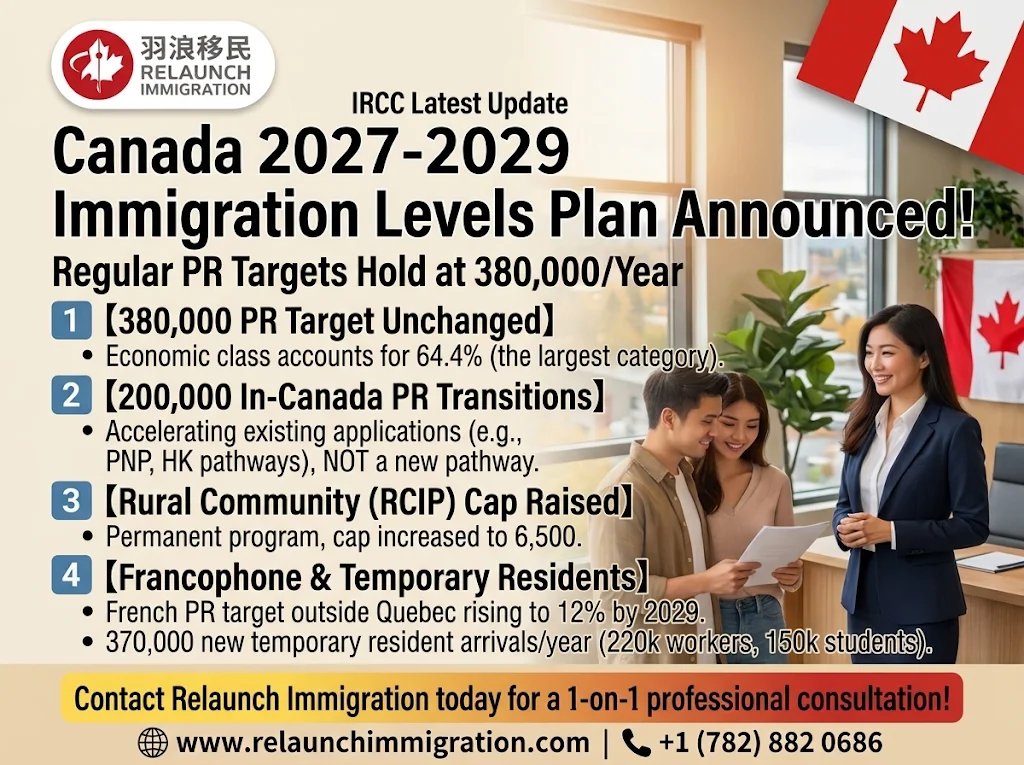
Over the next three years, Canada's regular permanent resident intake target will remain at 380,000 people annually. Concurrently, through specific measures, the government will support certain individuals who are already living and working in Canada to transition to permanent residency, while continuing to prioritize Provincial Nominee Programs, rural communities, and Francophone immigration outside Quebec.
For applicants, in addition to focusing on the overall quotas, it is crucial to understand which programs align with their qualifications and what actions they can actually take following the policy announcement.
I. Overview of Main Immigration Quotas for the Next Three Years
Below are the main categories and targets from Canada's 2027–2029 Immigration Levels Plan:
| Category | 2027 | 2028 | 2029 |
|---|---|---|---|
| Total Permanent Resident Target | 380,000 | 380,000 | 380,000 |
| Economic Class Total | 244,700 | 244,700 | 244,700 |
| Federal High-Skilled: CEC / FSW / FST | 100,000 | 100,000 | 100,000 |
| Provincial Nominee Program (PNP) | 95,000 | 95,000 | 95,000 |
| Atlantic Immigration Program (AIP) | 6,000 | 6,000 | 6,000 |
| Rural and Northern Immigration Class | 5,500 | 6,000 | 6,500 |
| Spouses, Partners, and Children | 66,000 | 66,000 | 66,000 |
| Parents and Grandparents | 15,000 | 15,000 | 15,000 |
| Refugees and Protected Persons Total | 49,300 | 49,300 | 49,300 |
| Humanitarian and Other | 5,000 | 5,000 | 5,000 |
The above lists the main categories; sub-categories are included in their respective totals and should not be double-counted. Targets for 2028 and 2029 are subject to annual adjustments.
Economic class immigration accounts for approximately 64.4% of the overall target, remaining the largest immigration category. However, the permanent resident intake target is not equivalent to the number of Express Entry invitations issued in that year, nor does it represent the number of newly opened application spots. One cannot solely rely on quotas to directly infer individual chances of invitation or selection scores.
II. What is the Measure for Up to 200,000 Inland PR Transitions?
The most anticipated measure in this announcement is the government's plan to provide additional permanent resident processing space in 2027, beyond the regular quota targets, for a total of up to 200,000 individuals, divided into two main groups: Work and Humanitarian.
IRCC has explicitly stated: this is not a new, independent immigration pathway, nor is it a fixed quota that increases annually. Applicants do not need to submit a separate '200,000-person plan' application for this measure. Eligibility and application requirements for their original programs must still be met.
Work Category: Up to 100,000 people
The official page states that this category primarily involves in-Canada workers outside Quebec and their families, including those who qualify for Provincial Nominee Programs, as well as some individuals who have already submitted PR applications under specific, now closed-to-new-applications programs and are awaiting decisions, such as:
- Start-up Visa Program.
- Federal Self-Employed Persons Program.
- Agri-Food Pilot.
- Designated Caregiver Pilot Programs.
Humanitarian Category: Up to 100,000 people
This category involves specific in-Canada cases already submitted, including the Hong Kong permanent residence pathway, the Ukraine Family Reunification Pathway, some in-Canada Spouses and Dependent Children applications, and humanitarian and compassionate grounds applications that have received approval in principle.
Therefore, simply being in Canada with a work permit or study permit is not sufficient to guarantee eligibility for this measure. Furthermore, the government processing existing cases from closed programs does not mean these programs have reopened for new applications.
III. RCIP Permanent: What Changes for Rural and Northern Immigration?
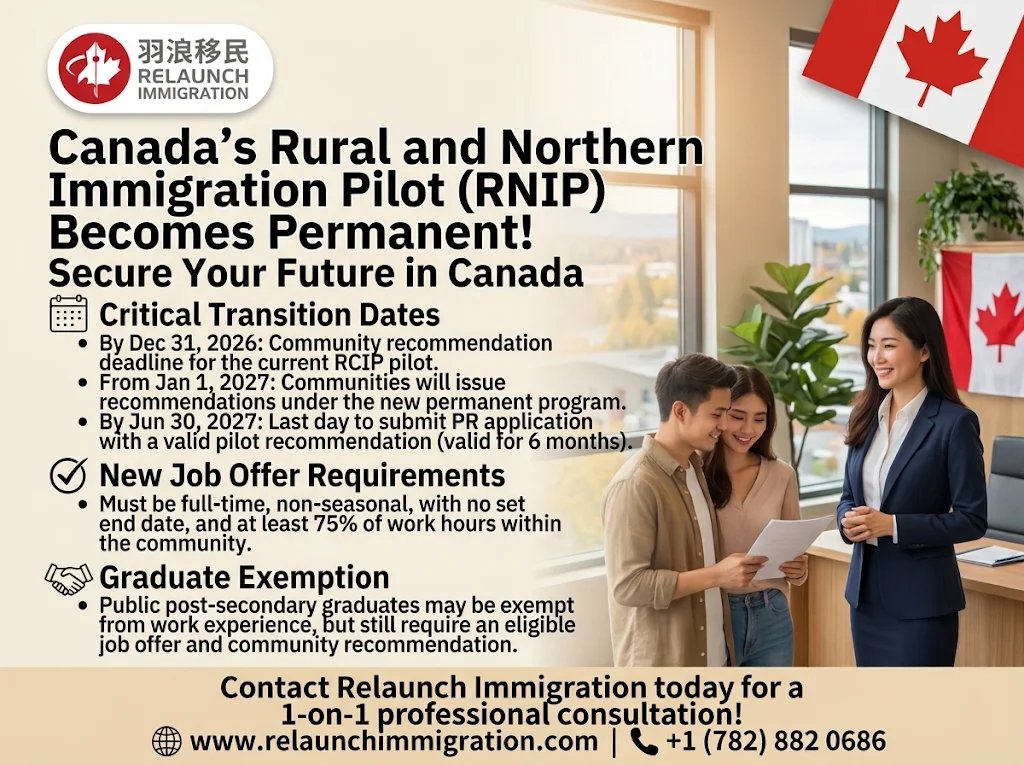
Rural and Northern Immigration is transitioning from a pilot to a permanent program. Relevant regulations were registered and came into effect on October 22, 2026; transitional arrangements listed in the Canada Gazette include:
- Communities can complete recommendations for existing pilots by December 31, 2026.
- Starting January 1, 2027, community allocations and recommendation arrangements under the new permanent program will take effect.
- The original pilot program instructions will remain in effect until June 30, 2027, allowing applicants with valid pilot recommendations to submit their applications under the corresponding rules.
The intake target for the Rural and Northern Immigration category will also gradually increase from 5,500 people in 2027 to 6,500 in 2029. However, these figures include some legacy RCIP and RNIP cases and should not be entirely viewed as new application spots for the permanent program.
Permanent status provides a more long-term institutional foundation for this pathway, but applicants must still meet the relevant conditions, including community recommendation, an eligible job offer, language proficiency, education, and work experience or applicable exemptions.
Our advice is: when considering the Rural and Northern pathway, assess local job opportunities, employer eligibility, living arrangements, and family adaptability simultaneously.
IV. French-speaking Immigrants Continue to Receive Policy Support
The target percentage of French-speaking permanent residents outside Quebec will increase annually:
| Year | Target Percentage for French-speaking Permanent Residents |
|---|---|
| 2027 | 9.5% |
| 2028 | 10.5% |
| 2029 | 12% |
These percentages target permanent resident intake outside Quebec and are not specific quotas for a single Express Entry draw category.
From a planning perspective, applicants who already have a foundation in French or are willing to invest time in improving their French language skills can re-evaluate how their language ability aligns with their immigration pathway. However, policy support should not be directly interpreted as a guaranteed invitation or a guarantee of lower scores in the future.
V. New Entry Workers and International Students: Annual Target of 370,000
The target for new temporary resident entries over the next three years is 370,000 people annually, including:
- Temporary Workers: 220,000 people.
- International Students: 150,000 people.
This is a new entry target, not the overall cap for all work permit and study permit applications in Canada. In-Canada work permit/study permit applications, renewals, and Post-Graduation Work Permits (PGWP) are not counted towards the new entry targets mentioned above.
Therefore, individuals already studying or working in Canada should not solely rely on the '150,000 international students' or '220,000 workers' figures to determine their own renewal or post-graduation plans.
VI. How Applicants Can Prepare Now?
We recommend re-evaluating your plan in the following three areas:
- 1. Confirm Eligibility First, Then Compare Pathways
Gather your language test results, educational credentials, work experience, and current status to identify any gaps between your profile and the requirements for Express Entry, Provincial Nominee Programs, AIP, or community-based immigration programs. - 2. Consider Job and Location Choices Together
If considering employer-specific or community-based pathways, evaluate the job position, employer eligibility, location, and long-term settlement intentions simultaneously. When choosing a city or school, also consider future employment and family life. - 3. Create a Clear Timeline
Integrate work permit or study permit expiry dates, language exams, educational credential assessments, work experience accumulation, and document preparation into a single timeline to identify priorities.
The new plan provides policy direction, but individual next steps must still be based on practical conditions.
Understand the Latest Plan, Chart Your Immigration Journey
Want to understand how this update relates to your situation? Feel free to contact Relaunch Immigration to assess suitable pathways together and plan your application preparation.
This article is compiled based on public information available as of November 6, 2026; specific eligibility and implementation details are subject to the latest announcements from IRCC, relevant provinces, and communities.