PGWP & Leave of Absence: Navigating Canada’s 150-Day Rule for International Students
Quick Navigation:
When applying for a Post-Graduation Work Permit (PGWP), applicants are generally required to maintain full-time student status in every academic term, with the exception of their final term, where part-time study may be permitted. This regulation is a crucial basis for Immigration, Refugees and Citizenship Canada (IRCC) to ensure international students are primarily focused on their studies.
If an international student has taken a temporary leave of absence during their studies, IRCC may further examine the following key aspects when processing a PGWP application:
- Was the leave officially approved by the school?
- Was the reason for the leave reasonable and acceptable?
- Did the leave exceed the stipulated 150-day limit?
- Did the student violate study permit conditions, such as working unauthorized, during the leave?
All these factors will directly impact PGWP eligibility.
I. What Qualifies as an "Authorized Leave of Absence"?
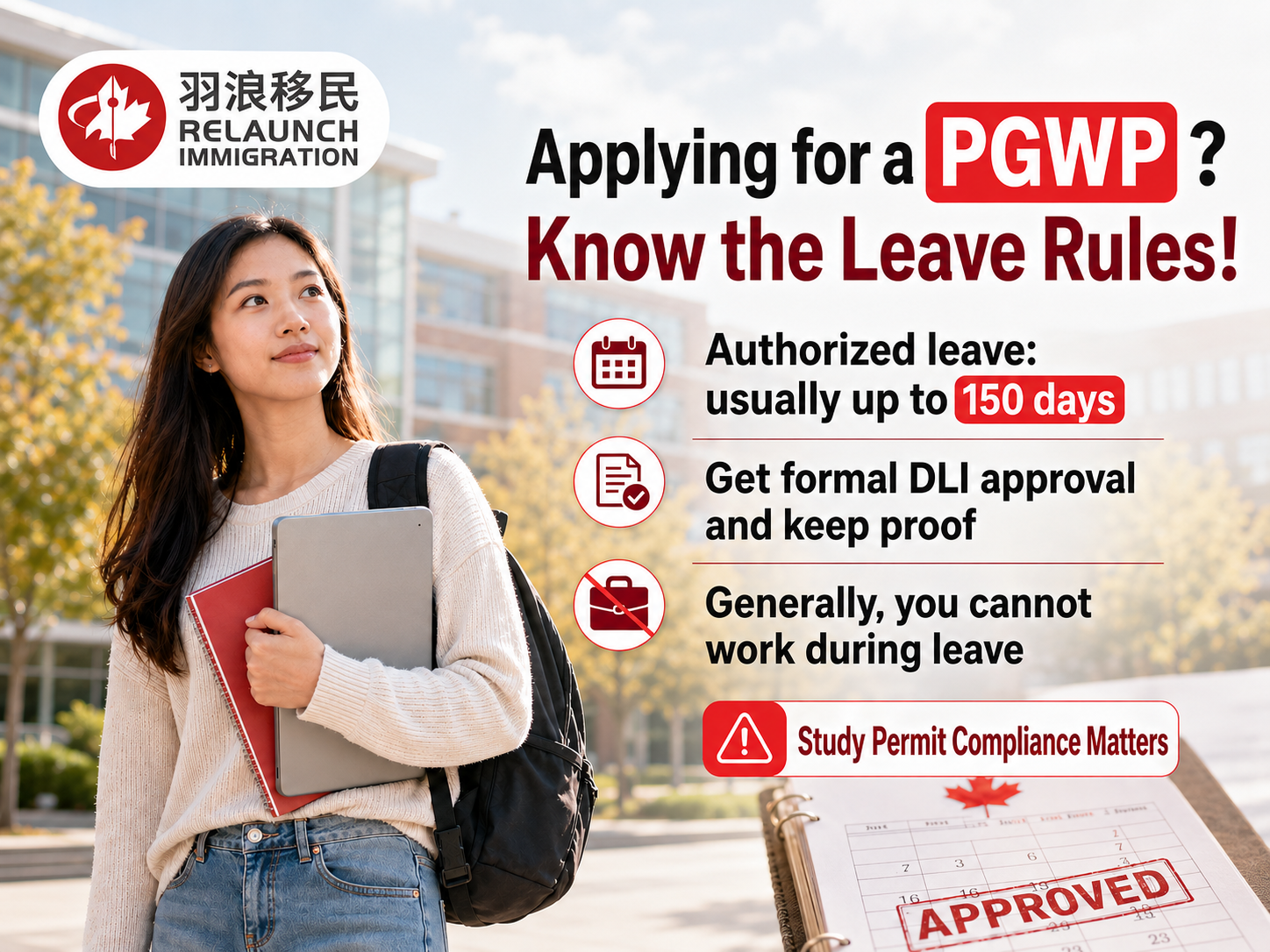
IRCC allows international students to take a temporary leave of absence under specific circumstances. As long as the leave is officially approved by the school and does not exceed 150 days, it may still be considered as continuous active study. Situations that qualify as an authorized leave include:
- Serious health issues or pregnancy requiring recovery
- Unexpected family emergencies
- Serious illness or death of a family member
- Other reasons officially approved and documented by a DLI (Designated Learning Institution)
- School permanent closure or significant strikes
- Study gaps resulting from transferring schools
- Delayed start dates for courses, either by the student or the school
Please note: If the situation involves a delayed enrollment, you must commence studies in the next available term, even if it is less than 150 days from the originally scheduled start date. You cannot continue to wait indefinitely.
II. The 150-Day Rule is Not a "Free Leave Period"
Many mistakenly believe that these 150 days are a "free leave period" during which students can decide to pause their studies at will. This is an incorrect interpretation. The 150-day rule applies to specific "authorized leave" scenarios, representing the maximum duration during which a student's status can still be considered valid.
Crucially, any leave of absence must receive official approval from your DLI. As an applicant, you must retain all relevant supporting documents for IRCC verification, such as:
- Official leave of absence approval letter from the school
- Documents detailing the reason for the leave and its start date
- Confirmation letter of return to studies from the school
- Past academic transcripts and current registration records
- Medical certificates or family situation proofs, if applicable
Furthermore, standard scheduled breaks arranged by the school, such as Summer break, Winter break, or Reading week, are part of the normal academic calendar and are distinct from individual "authorized leaves of absence." They do not require special application or cause concern regarding the 150-day rule.
III. Can I Work During an Authorized Leave?
Generally, the answer is "no."
Even if your study permit indicates that you are allowed to work on-campus or off-campus, you typically do not have the eligibility to work legally during an "authorized leave of absence." The conditions for working on a study permit are usually predicated on you being an "actively enrolled full-time student."
Continuing to work during a leave of absence could not only violate the conditions of your study permit but also severely jeopardize your future applications for a Study Permit extension, a Work Permit, or the Post-Graduation Work Permit (PGWP).
IV. What if My Leave Might Exceed 150 Days?
If your anticipated leave of absence might exceed 150 days, or if personal circumstances prevent you from resuming full-time studies within this period, "do not" simply remain in Canada waiting to resume. You should proactively take the following steps to avoid risks to your status:
- Resume full-time studies as soon as possible within the 150-day limit.
- Consider applying to change your status to a visitor to legally remain in Canada.
- If eligible, apply for another type of work permit (e.g., an open work permit or another employer-specific work permit that you qualify for) to change your status.
- If there are no other legal avenues to remain in Canada, consider leaving Canada temporarily and returning when you are ready to resume studies.
It is important to understand that exceeding 150 days does not necessarily mean your study permit will "automatically expire" on the 151st day. However, IRCC may determine that you are not actively pursuing studies or no longer meet study permit conditions, which will negatively impact your future PGWP application, study permit extension, and any other Canadian immigration applications.
V. How Does IRCC Know You Took a Leave?
Many international students wonder how IRCC tracks their academic status. The answer is: DLIs (Designated Learning Institutions) are required to regularly report the enrollment and academic status of all international students to IRCC.
Furthermore, IRCC may request detailed academic records from applicants in the following situations:
- Random compliance checks of student permits
- When processing study permit extension applications
- During the assessment of Post-Graduation Work Permit (PGWP) applications
At such times, IRCC may request documents including registration status, reasons for and start dates of leaves of absence, dates of withdrawal, suspension, or resumption of studies, official transcripts, and any school or medical certificates.
Most importantly: Applicants may not immediately see the information reported by their school to IRCC.
Therefore, if you have ever taken a leave of absence, transferred schools, or delayed your enrollment, we strongly advise you to confirm all records with your school early and properly retain all relevant approval documents. Do not wait until you apply for your PGWP to try and rectify issues, as it is often too late then.
Remember, the 150-day rule is just one important factor. Whether you ultimately obtain a PGWP still requires a comprehensive assessment of all your full-time study records in Canada, compliance with study permit conditions, and all other eligibility requirements.
Need assistance clarifying PGWP application issues?
Canadian immigration policies are complex and constantly evolving. If you have any questions about PGWP applications, or are unsure if your leave of absence situation meets the eligibility criteria, it's advisable to seek professional advice early to avoid issues due to insufficient information.
Relaunch Immigration possesses extensive experience in Canadian immigration applications, providing professional and trustworthy consultation services. You're welcome to book a consultation with us, and let us help you plan the most secure path to Canadian immigration.