Is Your Profession Your Canada Immigration Advantage? Assess Your Job Under New Express Entry Rules

Quick navigation:
- ➜ I. Understand the Reforms, Then Assess Your Opportunities
- ➜ II. IT & Tech Professionals: Your Skills are Your Strength, Preparation is Your Head Start
- ➜ III. Engineering Professionals: Turn Accumulated Expertise into Clear Next Steps
- ➜ IV. Finance & Accounting Professionals: Calculate Your Career, Re-evaluate Your Chances
- ➜ V. HR Professionals: You Guide Talent, Now Prepare for Your Own Next Move
- ➜ VI. Marketing & Management Professionals: Provide Clear Proof of Your Management Prowess
- ➜ VII. Educators: You Plan Futures for Students, Now Plan Your Own Next Steps
- ➜ VIII. No Matter Your Industry, You Can Complete These Three Things First
Working hard and gaining experience every day, you might be wondering: "With my profession and background, what else do I need to prepare to become a Canadian permanent resident?"
The recent adjustments to Express Entry (EE) are an opportunity for professionals in tech, engineering, finance, HR, marketing management, and education to re-examine their qualifications. How your occupation is classified, whether your experience counts, and the completeness of your documents will all impact your future planning.
Relaunch Immigration has compiled preparation guidelines for six fields to help you turn "Do I have a chance?" into concrete next steps.
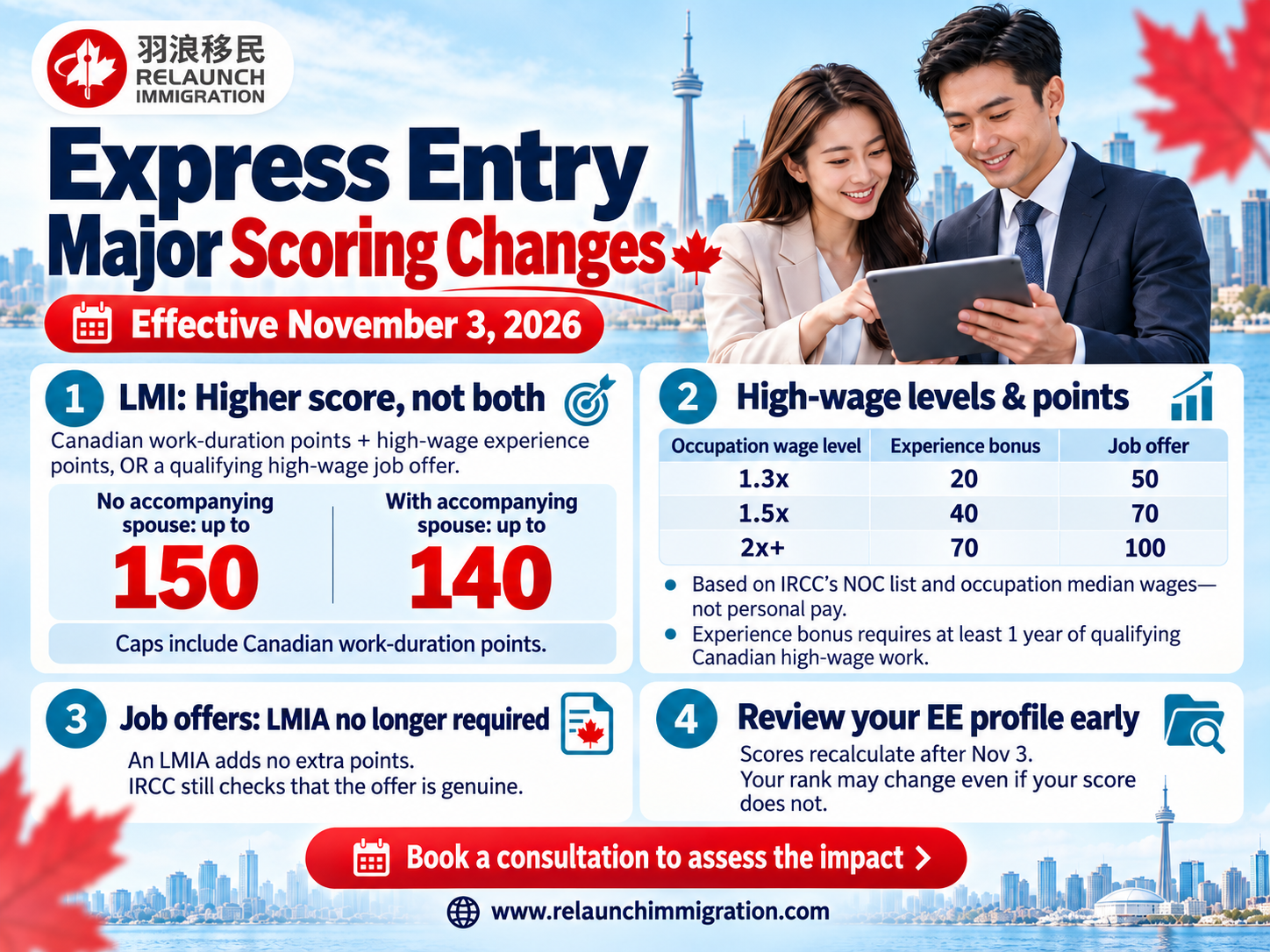
Data verification date: October 20, 2026. The new scoring system for Canadian work experience and job offers, as discussed in this article, is announced to take effect on November 3, 2026.
Understand the Reforms, Then Assess Your Opportunities
The new "high-wage occupations" are determined by official occupational classifications and national wage data; your personal salary level does not directly determine eligibility. The new Labour Market Integration (LMI) score will compare "points related to Canadian work experience" with "points for a qualifying job offer," adopting the higher of the two, and they cannot be directly combined.
For applicants, the first step is to confirm your NOC (National Occupational Classification) code. IRCC requires matching your actual job duties with the primary responsibilities of that occupation. Therefore, even if you are called a "manager," "consultant," or "engineer," you need to further examine your actual daily responsibilities.
The following occupational examples for six fields are provided to help you start your assessment; eligibility for bonus points or an invitation still requires evaluation based on your individual background.
IT & Tech Professionals: Your Skills are Your Strength, Preparation is Your Head Start
Software engineers and designers (21231), software developers and programmers (21232), data scientists (21211), and cybersecurity specialists (21220) are all listed in the announced new high-wage occupation list.
Here's what you can prepare now:
- Clarify the core of your technical work. Are you primarily responsible for system design, program development, data modeling, or cybersecurity analysis? First, organize your daily tasks, then cross-reference them with the corresponding occupational classifications.
- Clearly describe your personal involvement. Compile information on projects you participated in, your scope of responsibility, and duration of employment, ensuring your employment letter accurately reflects your work.
- Examine the nature of each experience. Full-time, part-time, freelance, and student work should be recorded separately, then confirm the applicable calculation rules.
- Plan language and academic preparation. Compare improving language scores, completing educational credential assessment, and continuing to accumulate experience to see which step best fits your current timeline.
If your job title is Developer, Analyst, or Consultant, it's worth performing a job duties cross-check first. Working at a tech company alone does not suffice to determine your occupational classification.
Engineering Professionals: Turn Accumulated Expertise into Clear Next Steps
Civil engineers (21300), mechanical engineers (21301), electrical and electronics engineers (21310), and industrial and manufacturing engineers (21321) are all listed in the new high-wage occupation list.
The key to preparing in the engineering field is to clearly present your professional role and responsibilities.
Here's what you can prepare now:
- Distinguish your job role. Verify whether you primarily engage in engineering design and analysis, technical support, on-site execution, or departmental management.
- Organize project experience. Record project types, duration of involvement, and your actual responsibilities in design, evaluation, supervision, or improvement.
- Confirm qualification arrangements. If you plan to work in a regulated occupation in Canada, research the license, registration, and qualification requirements for your target province in advance.
- Create a timeline. Review language exams, educational credential assessments, work experience accumulation, and status expiration dates together.
ECA for overseas education is used for immigration academic assessment; professional licensing qualifications must be handled according to the requirements of the relevant province or territory. These two preparations should be confirmed separately.
Finance & Accounting Professionals: Calculate Your Career, Re-evaluate Your Chances
Financial auditors and accountants (11100), financial and investment analysts (11101), and financial managers (10010) are all on the new high-wage occupation list.
Even when dealing with financial data, job content can include bookkeeping, auditing, analysis, or management. When preparing, you should clearly articulate your main responsibilities.
Here's what you can prepare now:
- Inventory the proportion of your daily tasks. For example, what percentage of your work time is spent on transaction recording, account reconciliation, auditing, investment analysis, budget planning, and financial decision-making?
- Make your employment proof more specific. The employment letter should accurately describe your scope of analysis, responsibilities, and hierarchical level.
- Organize academic and professional qualifications separately. Educational credential assessments for overseas degrees, accounting qualifications, or other professional certifications each have different uses and requirements that need to be verified.
- Re-evaluate overall conditions. Include age, language proficiency, education, work experience, and spouse's conditions in your Comprehensive Ranking System (CRS) score assessment.
Especially for positions like Bookkeeper, Accountant, and Financial Manager, you cannot determine the NOC solely based on Chinese translation or internal company titles; actual duties should be cross-referenced item by item.
HR Professionals: You Guide Talent, Now Prepare for Your Own Next Move
Human resources professionals (11200) and human resources managers (10011) are both included in the new high-wage occupation list.
HR work often spans recruitment, compensation, training, labor relations, and policy planning. To assess your opportunities, you can start by looking at these areas of responsibility.
Here's what you can prepare now:
- Organize core responsibilities. Specify whether you are mainly responsible for recruitment execution, personnel administration, policy development, employee relations, or HR department management.
- Present actual authority. If you hold a management position, outline your responsibilities regarding team, budget, policy, and decision-making.
- Keep records of career changes. If you have been promoted or transferred, record the start and end dates and job content for each phase separately.
- Verify document consistency. Your resume, contracts, employment letters, and salary records should clearly correspond to the same period of work experience.
For individuals who have gradually transitioned from personnel administration to professional or managerial roles, clearly organizing these changes in responsibilities is a valuable first step.
Marketing & Management Professionals: Provide Clear Proof of Your Management Prowess
Advertising, marketing and public relations managers (10022), corporate sales managers (60010), and business management consulting professionals (11201) are all listed in the new high-wage occupation list.
Job titles in this field are highly diverse. When preparing your documents, you should specifically demonstrate whether you are executing activities, providing professional consulting services, or responsible for departmental planning and management.
Here's what you can prepare now:
- Break down job content. List actual tasks such as strategic planning, ad placement, content creation, client acquisition, sales management, or operational improvements.
- Describe scope of responsibility. If management is involved, outline team division, budget authority, business objectives, and decision-making responsibilities.
- Present the consulting process. If engaged in management consulting, record problem analysis, improvement recommendations, and assistance in implementation.
- Review job offers. If you intend to assess eligibility based on a job offer, confirm the job content, employment terms, and whether your background supports the position.
The new system will still review the authenticity of job offers, including employer operations, ability to fulfill employment terms, and occupational demand.
Educators: You Plan Futures for Students, Now Plan Your Own Next Steps
Teachers, vocational training instructors, educational counsellors, and early childhood educators need to pay special attention: the scope of the high-wage occupation list differs from that of the education-sector-specific invitation rounds.
Below are examples of occupations mentioned in the poster:
- Secondary school teachers (NOC 41220): New high-wage occupation list Included; Current education-sector-specific list Included
- Elementary and kindergarten teachers (NOC 41221): New high-wage occupation list Included; Current education-sector-specific list Included
- College and other vocational instructors (NOC 41210): New high-wage occupation list Included; Current education-sector-specific list Not included
- Educational counsellors (NOC 41320): New high-wage occupation list Included; Current education-sector-specific list Not included
- Early childhood educators and assistants (NOC 42202): New high-wage occupation list Not included; Current education-sector-specific list Included
The above is a comparison of some occupations; inclusion on a list does not itself mean all application or invitation conditions are met.
Here's what you can prepare now:
- Confirm teaching or service recipients. Organize student ages, teaching stages, subjects, and institutional nature.
- Describe actual responsibilities. Differentiate between curriculum teaching, vocational training, educational counselling, early childhood education, and teaching support.
- Verify professional qualifications. Confirm registration or qualification requirements for teachers, early childhood educators, etc., in the target province.
- Check both sets of conditions separately. High-wage occupation-related scoring and education-sector-specific eligibility require separate verification of work location, experience duration, and other requirements.
Current education-sector-specific conditions include: accumulating at least twelve months of full-time or equivalent part-time experience in a single occupation on the list within the last three years, which can be from Canada or overseas and does not need to be continuous; simultaneously, basic EE eligibility and the requirements of the specific invitation round must still be met.
No Matter Your Industry, You Can Complete These Three Things First
- First, compile a complete work history timeline. List the country, company, job title, start and end dates, weekly hours, and main responsibilities for each period of employment. If you had promotions, part-time jobs, or concurrent roles, record them as well.
- Second, inventory existing supporting documents. First, check if contracts, employment letters, pay stubs, and tax records are complete, then supplement according to the document checklist for applicable items. Employment proof should support the experience you claim.
- Third, identify the most worthwhile next step to prioritize. This could be confirming your occupational code, preparing for language exams, arranging educational credential assessment, or completing an employment proof document. Clearly outlining your next step allows for more effective time and budget planning.
Want to know how to plan your profession now?
Contact Relaunch Immigration, specifying "EE Series 2 + Your Profession," and briefly provide:
- Age, highest education, and current location;
- Current job title and main job duties;
- Years of work experience in Canada and overseas;
- English or French scores, if available;
- Current immigration status and expiration date, if applicable.
We can help you clarify occupational classifications, inventory your current qualifications, and identify missing documents and preparation directions.
Your profession deserves to be understood, and your next step deserves early planning.
This article is for general information and preparation guidance; individual eligibility, scores, and application results must be evaluated based on actual background and applicable official regulations.