Canada Express Entry 2026 Reform: New Points for Work Experience, High-Paying Jobs, Job Offers & LMIA Changes Explained
Quick Guide to This Article:
- ➜ I. New "Labour Market Integration" Scoring Item
- ➜ II. How are High-Wage Occupations Defined?
- ➜ III. How Many Points for Work Experience and Job Offer?
- ➜ IV. EE Qualified Job Offers Will No Longer Require an LMIA
- ➜ V. If My Occupation Is Not on the High-Wage List, Will My Original Points Be Deducted?
- ➜ VI. For Those Already in the EE Pool, Please Note the Update Time
- ➜ VII. Distinguish Between Consulted Reforms and Announced Measures
- ➜ VIII. Latest French Category Invitation Also Issued Today
Today (October 16, 2026), IRCC announced Express Entry reforms, effective November 3, 2026. The key changes cover Canadian work experience, high-wage occupations, Job Offer points, and LMIA requirements. Relaunch Immigration has summarized everything for you!
I. New "Labour Market Integration" Scoring Item
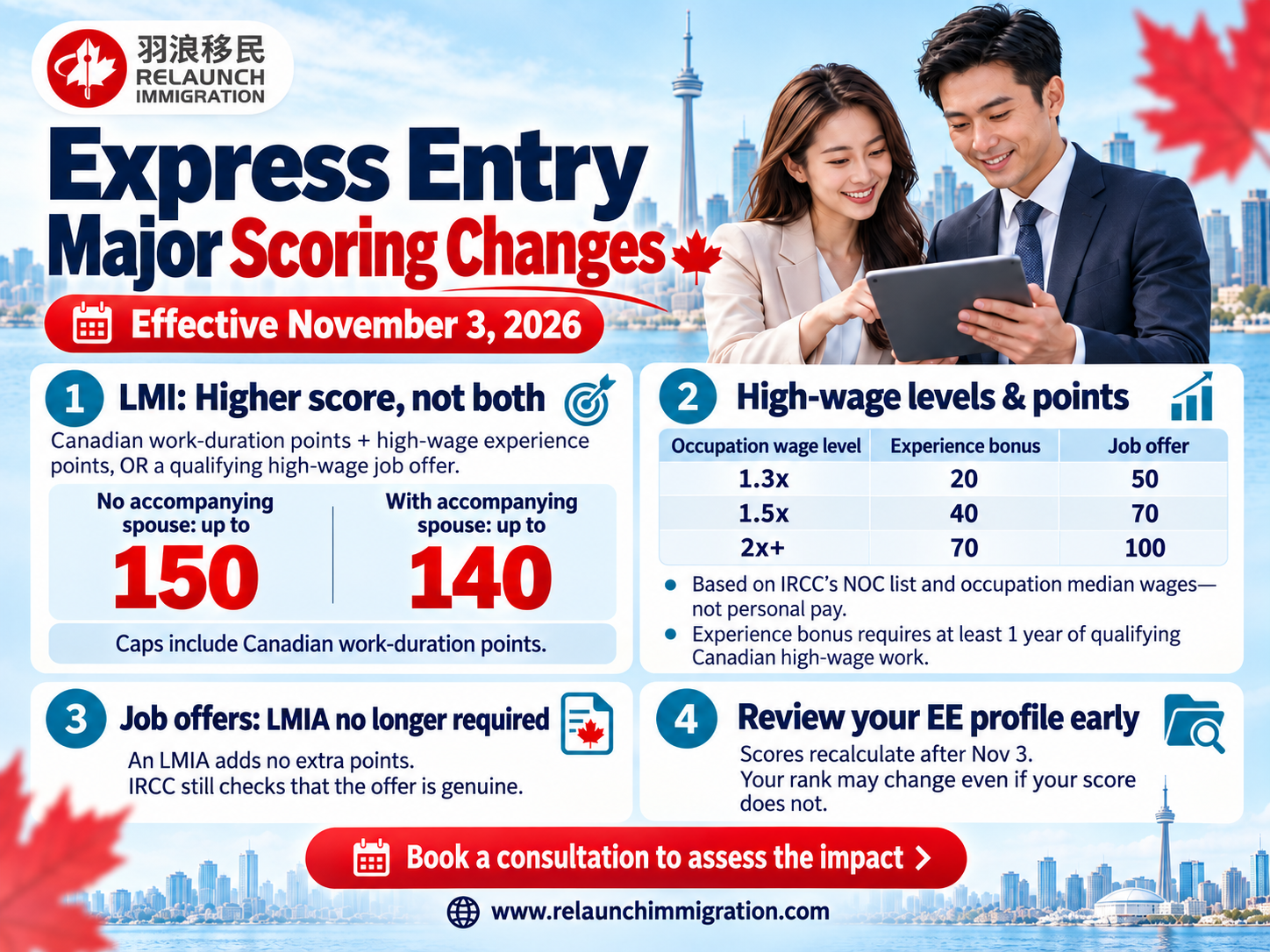
Labour Market Integration will compare the following two scoring methods:
- ✅ Canadian work experience points + qualified high-wage occupation experience points
- ✅ Qualified high-wage occupation Job Offer points
The higher of the two will be used; points cannot be stacked.
For applicants without an accompanying spouse/common-law partner, this category offers a maximum of 150 points; with an accompanying spouse/common-law partner, a maximum of 140 points. This is the maximum for the category, including Canadian work experience points, not an additional 150 points for everyone.
II. How are High-Wage Occupations Defined?
IRCC classifies NOC occupations based on their median wages across Canada, determining if they reach 1.3 times, 1.5 times, or 2 times the national overall median wage.
Eligibility is based on the official published NOC list. An individual's actual salary or the title "Manager" itself does not directly determine qualification.
The current list uses 2023–2025 data, covering certain healthcare, technology, engineering, education, trades, and management occupations.
III. How Many Points for Work Experience and Job Offer?
The table below shows the additional points for qualified work experience and Job Offers under high-wage occupation categories:
Official Occupation Wage Level
1.3x to less than 1.5x
1.5x to less than 2x
2x or more
Qualified Canadian Work Experience Additional Points
20 Points
40 Points
70 Points
Qualified Job Offer Points
50 Points
70 Points
100 Points
Additional points for work experience require at least one year of qualifying Canadian high-wage occupation experience; this can be non-continuous or combined from different qualifying occupations according to official rules. Points for each level are not cumulative; work experience and Job Offer points are still calculated based on the higher of the two, as described above.
IV. EE Qualified Job Offers Will No Longer Require an LMIA
Effective November 3, Job Offers used for the above EE points, and those meeting the conditions for relevant FSW/FST programs, will no longer require an LMIA; holding an LMIA itself will also not provide additional points or priority processing.
However, Job Offers must still meet relevant regulations. IRCC will review whether the employer is operating normally, if the hiring need is reasonable, if they can fulfill the employment conditions, and if the applicant is capable of performing the job. Generally, employment must cover at least one year of full-time, continuous work after obtaining PR, with specific regulations for some occupations.
V. If My Occupation Is Not on the High-Wage List, Will My Original Points Be Deducted?
Points for qualifying Canadian work experience will still be retained, and skill transferability rules have not changed due to this reform.
Job Offers for non-high-wage occupations may still be used to meet the eligibility requirements of relevant immigration programs, but they will not qualify for the newly added high-wage Job Offer points.
We also remind everyone: even if your score remains unchanged, other candidates' scores may increase, potentially altering your relative ranking within the pool. Subsequent invitation thresholds will need continuous monitoring, and gaining points does not guarantee an invitation.
VI. For Those Already in the EE Pool, Please Note the Update Time
The system will automatically recalculate scores for existing profiles after the new rules take effect. This process may take up to two weeks, during which time invitations will be paused and will resume once completed.
Applicants hoping to obtain qualified Job Offer points should verify and complete relevant information before November 3.
VII. Distinguish Between Consulted Reforms and Announced Measures
Recent consultation reports have also discussed issues such as merging federal immigration programs, adjusting age points, and points for spouses, siblings, and Canadian study experience.
These remain part of consultations and subsequent policy research and should not be directly considered as rules confirmed for implementation on November 3.
VIII. Latest French Category Invitation Also Issued Today
On October 16, a total of 5,000 invitations were issued for the French category draw, with a minimum CRS of 435 points; this draw occurred before the new scoring rules took effect.
Review Your Express Entry Profile Now!
Now is the time to re-examine your NOC, work experience, Job Offer, and EE profile.
Message us with "EE" to let us help you confirm the actual impact of this update on you, assess the points you can aim for, and plan your next steps.