Is a Local Job in Canada Enough? New Brunswick PNP Restricts Pathway to 3 Sectors—The Harsh Reality of 2026 Provincial Nominations
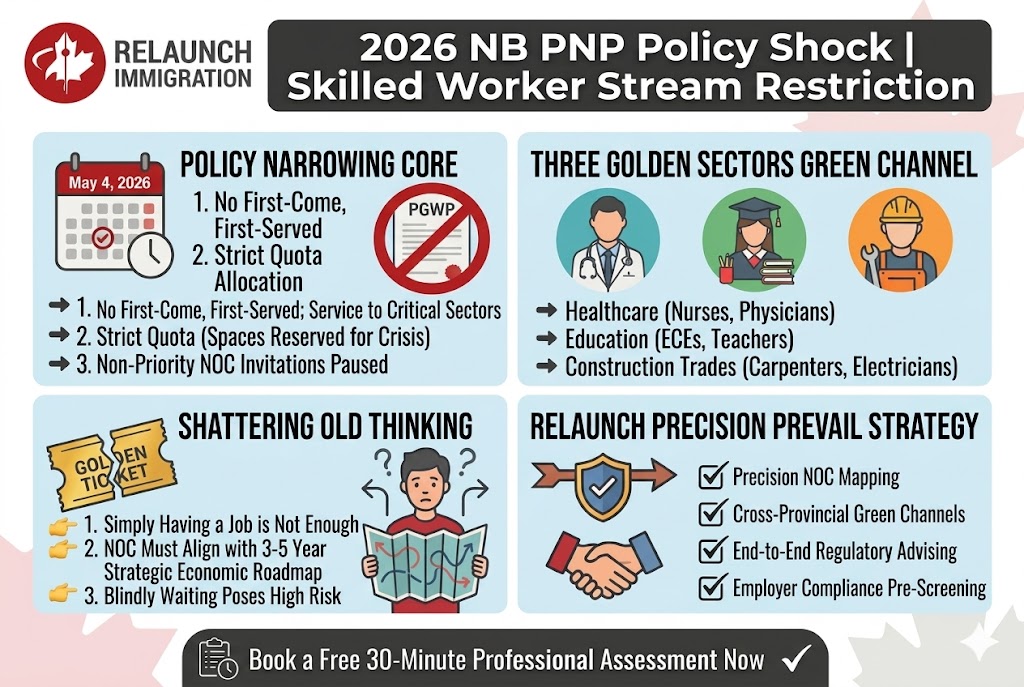
🍁 On May 4, 2026, the New Brunswick Provincial Nominee Program (NBPNP) underwent a historic policy shift. The provincial government released an urgent official notice stating that due to a highly restricted nomination quota allocated by the federal government (IRCC) for the year, New Brunswick is drastically narrowing its focus for the NB Experience Pathway under the Skilled Worker stream. The golden era of "as long as you graduate or work locally, PR is guaranteed" has officially come to an end.
Quick Navigation:
- ➜ I. NB Policy Shockwave: Target Restrictions Effective May 4, 2026
- ➜ II. Three Golden Sectors: Who Retains Priority Invitation Rights?
- ➜ III. Shattering the Old Playbook: Working Locally is No Longer a Golden Ticket
- ➜ IV. Relaunch Insights: Proactive Adjustments to Navigate the Policy Shift
- ➜ V. How Relaunch Immigration Fast-Tracks Your PR Success
I. NB Policy Shockwave: Target Restrictions Effective May 4, 2026
According to the latest official notice published by Immigration New Brunswick, effective May 4, 2026, all new Invitations to Apply (ITAs) under the NB Experience pathway of the Skilled Worker Stream are restricted strictly to candidates employed in specific high-demand sectors until further notice. This drastic measure was implemented due to the limited remaining provincial nomination spaces available for the 2026 calendar year.
✅ Quota Strategization: Nominations are no longer issued on a first-come, first-served basis or simply because an employer supports the application. The remaining spaces are strictly reserved for critical labor crises.
✅ Non-Priority Profiles Sidelined: If your National Occupational Classification (NOC) code does not fall under the targeted sectors, your existing Expression of Interest (EOI) will sit in the pool indefinitely without any invitation prospects.
II. Three Golden Sectors: Who Retains Priority Invitation Rights?
This policy adjustment is not a total shutdown, but rather a hyper-targeted funneling of resources. The government explicitly declared that only applicants currently working full-time in one of the following three golden priority sectors will continue to receive ITAs:
- Healthcare (🩺): Frontline nurses, family physicians, paramedics, and specialized medical technicians.
- Education (🎓): Early childhood educators (ECEs), elementary/secondary school teachers, and specialized trade instructors.
- Construction Trades (🔨): Carpenters, electricians, plumbers, heavy equipment operators, and other foundational infrastructure professionals.
This trend isn't isolated to New Brunswick. Across the Atlantic provinces through the Atlantic Immigration Program (AIP) and in various other PNPs across Canada, these three industries have become the long-term, fast-track "green channels" of 2026. Detailed program regulations can be verified on the official NB Skilled Worker Stream Guide Page.
III. Shattering the Old Playbook: Working Locally is No Longer a Golden Ticket
For over a decade, the standard blueprint for Canadian immigration has been: "Pick a lower-barrier province ➡️ Graduate ➡️ Get a Post-Graduation Work Permit (PGWP) ➡️ Land any job in retail or food service ➡️ Accumulate 6 to 12 months of experience ➡️ Secure employer signing ➡️ Apply for PR."
With tightly capped provincial allocations, merely maintaining a stable local life or securing employer backing is no longer enough. If your NOC job code doesn't align with the province's 3-to-5-year strategic economic roadmap, working there indefinitely might just mean contributing to local tax revenues without ever securing your permanent residency.
IV. Relaunch Insights: Proactive Adjustments to Navigate the Policy Shift
Facing a tightening immigration landscape, Relaunch Immigration reminds all applicants: Anxiety won't yield status, but proactive data analysis and long-term policy mapping will! Planning your study or career path in Canada today requires looking past "easy job access" or "current cut-off scores."
Before launching your journey or switching jobs, you must ask yourself two core questions: First, does my NOC code align with the province’s critical shortage list? Second, do I place in the top tier of provincial priority rankings? If you are currently in accommodation, food services, or general administrative roles, you should immediately evaluate turning to an assistant position within a priority sector or considering a cross-provincial pivot before pathways lock up completely.
V. How Relaunch Immigration Fast-Tracks Your PR Success
When policies shift overnight, blind effort cannot beat strategic positioning. The expert team at Relaunch Immigration brings years of elite legal and regulatory experience in Canadian immigration, leveraging robust data analytics to help you anchor your path amidst the policy storm:
Conclusion: Blind Waiting is High Risk; Proactive Adjustment is True Security
The abrupt 2026 restrictions on the New Brunswick Experience pathway send a crystal-clear signal: Canada’s doors are open primarily for those who can immediately address local labor shortages. If your study direction or current work permit is impacted by these waves, remaining stationary is your biggest risk.
Do not let outdated info compromise your future in Canada. Contact us today or book a "Relaunch Immigration 30-Minute Professional Assessment," and let the industry's most forward-thinking team reposition you for PR success!